

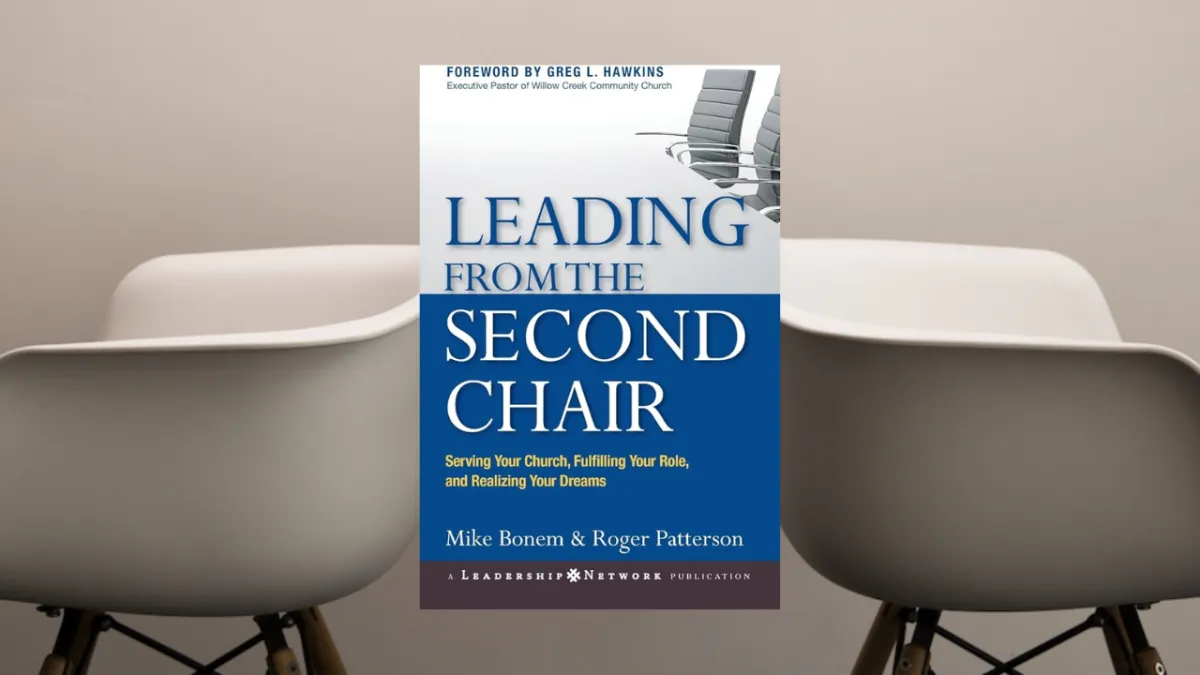
Leading From the Second Chair
Why This Book Still Matters for Both Executive and Lead Pastors
There are few books that have shaped the understanding of the Executive Pastor role more than Leading From the Second Chair by Mike Bonem and Roger Patterson.
For years now, this book has served as a foundational resource for those serving in what’s often called the “second chair” role—whether that title is Executive Pastor, Associate Pastor, or another senior leadership position just under the lead pastor.
And while many Executive Pastors have read it, what’s often overlooked is how valuable this book is for Lead Pastors as well—especially those stepping into a working relationship with an Executive Pastor for the first time.
This isn’t just a book about roles. It’s a book about relationships, influence, and organizational health.
What Is the “Second Chair”?
At its core, the book defines the “second chair” as the leadership position directly under the primary leader—the person responsible for helping translate vision into reality.
That’s a description every Executive Pastor immediately recognizes.
But Bonem and Patterson go further. They don’t define the role by job description, but by function:
Leading without being the top authority
Influencing without ultimate control
Carrying responsibility without final say
That tension is real. And it’s where many Executive Pastors either thrive… or struggle.
For new Executive Pastors, this is one of the most important early lessons: success in the role is not about authority—it’s about influence, alignment, and trust.
The Three Key Realities of the Second Chair
One of the most helpful contributions of the book is its articulation of three ongoing tensions that second-chair leaders must navigate:
1. Subordinate Yet a Leader
Executive Pastors are fully leaders—and yet they are not the lead pastor.
That means:
They must lead teams, systems, and strategy
While also submitting to the vision and authority of another leader
This dual reality creates a constant need for humility and confidence to coexist.
For new Executive Pastors, this can feel disorienting. For Lead Pastors, it’s a reminder: your Executive Pastor is carrying real leadership weight, even while honoring your authority.
2. Deeply Loyal Yet Willing to Challenge
The best Executive Pastors are fiercely loyal to their Lead Pastor—but they’re not silent.
They:
Protect the vision
Speak truth in private
Offer pushback when needed
This is one of the most critical dynamics in a healthy church leadership structure.
Executive Pastors must learn how to challenge without threatening.
Lead Pastors must learn how to receive challenge without becoming defensive.
When this works well, it creates one of the strongest leadership duos in the church.
3. Content in the Second Chair
This may be the most important—and the most overlooked—principle.
Second-chair leaders must be genuinely content not being the first chair.
That doesn’t mean a lack of ambition. It means clarity of calling.
Executive Pastors who are constantly striving to become the Lead Pastor will struggle in the role. Those who embrace their assignment—leading through influence, systems, and execution—will thrive.
And Lead Pastors need to understand this as well. Hiring someone who is truly wired for the second chair is critical.
The Four Types of Second-Chair Leaders
Bonem and Patterson also describe different ways second-chair leaders function within organizations. While not rigid categories, they help clarify how Executive Pastors can operate based on gifting and context:
The Administrator – focuses on systems, structure, and execution
The Catalyst – drives momentum and change
The Relational Leader – builds trust and team cohesion
The Partner – works closely alongside the Lead Pastor in shared leadership
Most Executive Pastors are a blend of these, but understanding your dominant wiring is key.
For the Executive Pastor, this brings clarity to how they lead best.
For the Lead Pastor, it helps answer a critical question: What kind of second-chair leader do I actually need?
The Importance of the Lead Pastor Relationship
If there’s one theme that rises above the rest in this book, it’s this:
Everything rises and falls on the relationship between the first chair and the second chair.
The Executive Pastor can build systems, lead staff, and create clarity—but none of it will be sustainable without a strong, trust-filled relationship with the Lead Pastor.
The book emphasizes several key practices:
Regular, honest communication
Clear expectations and defined responsibilities
Mutual trust and shared wins
Public alignment and private candor
From an Executive Pastor perspective, this reinforces the idea of being the Clarity Champion—ensuring that what the Lead Pastor says is what the organization understands and executes.
From a Lead Pastor perspective, it’s a reminder that the Executive Pastor is not just an implementer—they are a strategic partner.
Why This Book Matters for Executive Pastors
For those new to the role, Leading From the Second Chair provides something incredibly valuable: language.
It helps articulate:
Why the role can feel complex
Why tension is normal, not a sign of failure
How influence actually works in a second-chair position
It also provides permission—to lead boldly while staying aligned, to speak up while remaining loyal, and to embrace a role that is both strategic and supportive.
For experienced Executive Pastors, the book serves as a reset.
It brings you back to the fundamentals:
Alignment over independence
Influence over authority
Relationship over structure
These are the anchors that keep the role healthy over the long haul.
Why This Book Matters for Lead Pastors
This is where many miss the opportunity.
Lead Pastors often assume this is a book for Executive Pastors. In reality, it may be just as important for them.
Why?
Because many of the frustrations Lead Pastors experience with their Executive Pastor are rooted in misunderstanding the role itself.
This book helps Lead Pastors:
Set realistic expectations
Understand the internal tension their Executive Pastor carries
Create space for honest feedback
Build a true partnership rather than a hierarchical reporting line
If a Lead Pastor wants a strong Executive Pastor, they must create an environment where that leader can actually function in the second chair.
That doesn’t happen by accident. It happens by design.
Final Thoughts
Leading From the Second Chair remains one of the most practical and insightful books available for church leadership teams navigating the Lead Pastor–Executive Pastor relationship.
For Executive Pastors, it clarifies the role and strengthens their approach to leadership.
For Lead Pastors, it provides a roadmap for building a partnership that leads to greater clarity, alignment, and organizational health.
And at the end of the day, that’s what this is really about.
When the first chair and second chair are aligned:
Vision becomes clear
Systems become effective
Staff becomes unified
And the church becomes healthier
That’s not just good leadership. That’s good stewardship.





Facebook
Instagram
X
LinkedIn
Youtube